
 Facebook
 X
X LinkedIn
 Forward
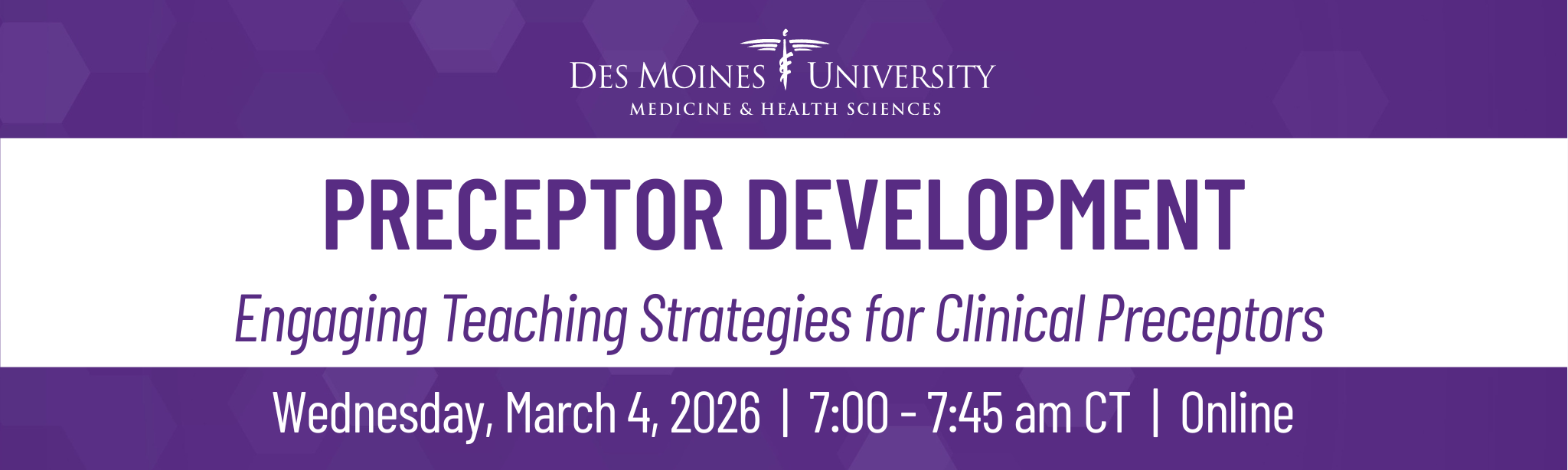
Engaging Teaching Strategies for Clinical Preceptors

| Registration |
|---|
|
Purpose
Empower your teaching in real-world clinical settings. Developed in collaboration with experienced preceptors, this program focuses on the areas they identified as most critical for success. Sessions feature practical strategies, interactive activities, and quick-reference tools focused on efficient teaching, learner evaluation, feedback delivery, and sustainability. Join us to strengthen your skills, streamline your workflow, and make every teaching moment count.
Description
This session supports clinical preceptors in strengthening their teaching and facilitation skills during busy clinical rounds using concise, evidence-based strategies that integrate seamlessly into patient care. Aligned with the ACGME Clinician-Educator Milestone: Educational Theory and Practice 1 (Teaching and Facilitating Learning), the session emphasizes self-assessment and intentional teaching behaviors that promote learner development in real time.
Grounded in findings from a systematic literature review, participants will focus on two high-impact approaches, the One-Minute Preceptor model and effective bedside teaching, to enhance clinical reasoning, engage learners at varying levels, and provide timely feedback. Using a before-during-after rounds framework, the session demonstrates how brief preparation, targeted questioning, and rapid reflection can transform routine clinical encounters into meaningful learning experiences.
Learning Objectives
- Self-assess their clinical teaching practices in relation to the ACGME Clinician-Educator Milestone: Educational Theory and Practice 1.
- Prepare efficiently for teaching during rounds by setting clear learning goals and orienting learners in under four minutes.
- Apply the One-Minute Preceptor model to promote clinical reasoning, probe learner understanding, and deliver targeted teaching points during rounds.
- Use intentional bedside teaching strategies that balance learner engagement, patient-centered care, and time constraints.
- Deliver brief, actionable feedback after rounds to reinforce learning and support learner growth.
Moderator
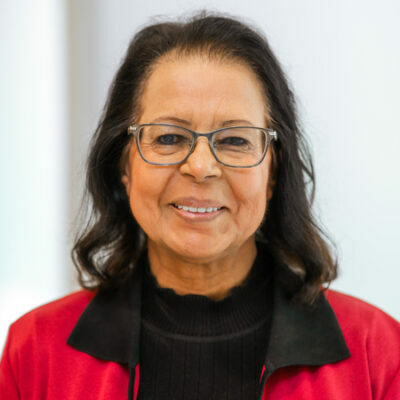
Nehad El-Sawi, PhD
Assistant Vice President for Academic Innovation and Enhancement, Office of Academic Affairs, Des Moines University Medicine and Health Sciences
Speaker
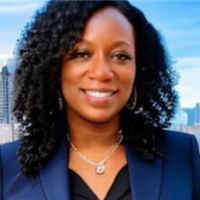
Lydia Elliott, EdD
Dr. Elliott is the Director of Faculty Development at the Carle Illinois College of Medicine, where she leads institution-wide initiatives in engineering-based medical education, innovative teaching, and data-driven curriculum improvement. Her work focuses on supporting faculty and residents as educators through innovative professional development, accessible digital learning, and equitable assessment practices. Dr. Elliott collaborates across clinical, foundational science, and engineering domains to build scalable faculty development ecosystems that align with accreditation standards and institutional strategy. She is particularly passionate about intentional small-group facilitation, learning analytics for improvement, and preparing the next generation of clinician-educators.
Course summary
- 0.75 AMA PRA Category 1 Credits™
- 0.75 AOA Category 2A
- 0.75 CE Contact Hour(s)
- 0.75 CPME
Accreditation Statements
- DO: Des Moines University Medicine and Health Sciences (DMU) is accredited by the American Osteopathic Association (AOA) to provide osteopathic continuing medical education for physicians. DMU designates this activity for a maximum of 0.75 AOA Category 2-A credits and will report CME and specialty credits commensurate with the extent of the physician’s participation in this activity.
- DPM: Des Moines University Medicine and Health Sciences (DMU) is approved by the Council on Podiatric Medical Education as a provider of continuing education in podiatric medicine. DMU has approved this activity for a maximum of 0.75 continuing education contact hours.
- MD: This activity has been planned and implemented in accordance with the accreditation requirements and policies of the Iowa Medical Society (IMS). Des Moines University Medicine and Health Sciences (DMU) is accredited by the IMS to provide continuing medical education for physicians. DMU designates this live activity for 0.75 AMA PRA Category 1 Credit(s)™. Physicians should claim only the credit commensurate with the extent of their participation in the activity.
- Other healthcare providers: This activity is designated for 0.75 AMA PRA Category 1 Credit(s)™.
 |  |
Educational Grants
No ineligible company provided financial support for this continuing education activity.
DISCLOSURE
The speaker(s) will disclose if any pharmaceuticals, medical procedures, or devices discussed are investigational or unapproved for use by the U.S. Food and Drug Administration (FDA). The activity director is responsible for determining educational content and selecting speakers.
Relevant to the content of this educational activity, the following individual(s) have no conflict(s) with ineligible companies to disclose.
- Nehad El-Sawi, PhD - Activity Director and Moderator
- Lydia Elliott, EdD - Speaker
DISCLAIMER
The information provided in this activity is for continuing education purposes only. It is not a substitute for a healthcare provider's independent medical judgment regarding diagnostic and treatment options for a specific patient's medical condition.
Available Credit
- 0.75 AMA PRA Category 1 Credits™
- 0.75 AOA Category 2A
- 0.75 CE Contact Hour(s)
- 0.75 CPME
Price
There is no cost to attend. Preceptors and clinical instructors are invited to attend.